Hi all:
I have moved off Blogger.
I now am the editor-in-chief of a cinema website called Tour de Force.
That's where my film reviews are posted.
Come see me there.
And bookmark it!
The URL is:
http://tour-de-force.net/
BILL
Thursday, November 08, 2012

Thursday, September 20, 2012
The Master: Beautifully Filmed But Thin on Ideas

Anderson is clearly interested in L. Ron Hubbard and the religion (if you can call it that) that he founded. I am too. I think Hubbard is one of the most fascinating figures of the 20th century. But Anderson doesn't have anything significant to say about Hubbard or his followers. "The Master" just describes its subject. It doesn't really have substance as a work of art. In the immortal words of Gertrude Stein, there's no there there.
It is beautifully filmed, and its
descriptions of Hubbard and the Scientology movement are interesting. It also
surprisingly held my interest for the long running time (almost two-and-a-half
hours). But ultimately I felt it never produced significant insights. It
doesn't even raise many interesting questions. It just describes. There is a lot of gripping description but not much more than that.
Philip Seymour Hoffman plays the thinker (Hubbard). Amy Adams plays his wife. Joaquin Phoenix (trying to resurrect his career after the fiasco of "I'm Still Here," his idiotic faux-documentary from 2010) plays a hyper-active Navy veteran trying to reintegrate into American society at the end of WWII. The film is particularly interested in the surprising bond that develops between this lonely, alcoholic ex-sailor and "the Master." But nothing significant ever gets said about this bond. It's just described.
Phoenix's performance is often quite irritating. Most times it appears he is attempting to do 1950s-style Method acting, with a kinetic, body-shaking style. This often came across to me like a narcissistic college student in his first Acting class impersonating Marlon Brando. Phoenix is not so much an actor as a good impersonator. Making matters worse is the fact that Phoenix speaks most of his lines through one side of his mouth. Half his lines are hard to decipher. I got so sick of struggling to understand him.
Much easier to understand are Hoffman and Adams. They give crystal-clear, open performances that often shimmered with inspiration. I loved how Adams brought fire and power to her role. Wives of leaders are often throw-away roles, but Adams brings this character to ferocious life. Often it seems that she's more the driving force behind Scientology than her husband is. She's the one driving him to write the books.
But "The Master" never really comes together. It meanders around as aimlessly as the Phoenix character. Sometimes aimlessness is depicted in a compelling way, such as in Kenneth Lonergan's rich and original film from 2000, "You Can Count on Me," which launched Mark Ruffalo's career. But this isn't a stirring exploration of a lost soul. It's a feckless one that only scratches surfaces.
It's a disappointing follow-up to Anderson's far more trenchant and penetrating "There Will Be Blood" (2007). But Anderson remains one of America's most interesting filmmakers. "The Master" may not be a home run, but at least Anderson directs his attention to interesting subjects and is not just producing popcorn movies. Anderson does not want to be a billionaire; he wants to be an artist. In that sense, he is a treasure in this age of empty commercialism.
Philip Seymour Hoffman plays the thinker (Hubbard). Amy Adams plays his wife. Joaquin Phoenix (trying to resurrect his career after the fiasco of "I'm Still Here," his idiotic faux-documentary from 2010) plays a hyper-active Navy veteran trying to reintegrate into American society at the end of WWII. The film is particularly interested in the surprising bond that develops between this lonely, alcoholic ex-sailor and "the Master." But nothing significant ever gets said about this bond. It's just described.
Phoenix's performance is often quite irritating. Most times it appears he is attempting to do 1950s-style Method acting, with a kinetic, body-shaking style. This often came across to me like a narcissistic college student in his first Acting class impersonating Marlon Brando. Phoenix is not so much an actor as a good impersonator. Making matters worse is the fact that Phoenix speaks most of his lines through one side of his mouth. Half his lines are hard to decipher. I got so sick of struggling to understand him.
Much easier to understand are Hoffman and Adams. They give crystal-clear, open performances that often shimmered with inspiration. I loved how Adams brought fire and power to her role. Wives of leaders are often throw-away roles, but Adams brings this character to ferocious life. Often it seems that she's more the driving force behind Scientology than her husband is. She's the one driving him to write the books.
But "The Master" never really comes together. It meanders around as aimlessly as the Phoenix character. Sometimes aimlessness is depicted in a compelling way, such as in Kenneth Lonergan's rich and original film from 2000, "You Can Count on Me," which launched Mark Ruffalo's career. But this isn't a stirring exploration of a lost soul. It's a feckless one that only scratches surfaces.
It's a disappointing follow-up to Anderson's far more trenchant and penetrating "There Will Be Blood" (2007). But Anderson remains one of America's most interesting filmmakers. "The Master" may not be a home run, but at least Anderson directs his attention to interesting subjects and is not just producing popcorn movies. Anderson does not want to be a billionaire; he wants to be an artist. In that sense, he is a treasure in this age of empty commercialism.
Tuesday, September 11, 2012
Top 10 Films of 2012 So Far

These are my top 10 films of 2012 so far (as of September 1):
1. Killer Joe
"Killer Joe," from director William Friedkin
("The Exorcist," "Cruising"), is a merciless depiction of human depravity and a very good film,
Friedkin's best since the 1970s.
A family of trailer-park trash hires a hitman (Matthew McConaughey, shown above), and he insinuates himself into the family in some interesting and nauseating ways. When a double-cross occurs, all hell breaks loose. The direction is crisp and brilliant. The actors all know what they're doing and do it well. The cinematography is perfectly dank and lurid. The screenplay bristles with creativity and punch. And the editing is a tour de force, moving everything along at an exhilarating pace.
A family of trailer-park trash hires a hitman (Matthew McConaughey, shown above), and he insinuates himself into the family in some interesting and nauseating ways. When a double-cross occurs, all hell breaks loose. The direction is crisp and brilliant. The actors all know what they're doing and do it well. The cinematography is perfectly dank and lurid. The screenplay bristles with creativity and punch. And the editing is a tour de force, moving everything along at an exhilarating pace.
Let's hear it for McConaughey, who is having an amazing year. He did remarkable work in Richard Linklater's "Bernie," Steven Soderbergh's "Magic Mike," and now "Killer Joe." He's brought fearlessness, skill, and depth to all these roles.
Did I mention the chicken drumstick? After seeing this film, you will never look at KFC the same way again.
Did I mention the chicken drumstick? After seeing this film, you will never look at KFC the same way again.
2. Moonrise Kingdom
I am not a big fan of Wes Anderson's work generally. I often
find his films charming but shallow. But "Moonrise Kingdom” is so perfectly realized that one can forget that it's rather simple and
just revel in its charm, quirkiness, and humanity. Rarely has a film radiated such love for its broken, struggling characters as “Moonrise Kingdom.” I was particularly moved by hints of sadness and
complexity floating through the supporting performances from the stellar ensemble cast, which includes Frances
McDormand, Bill Murray, Bruce Willis, and Edward Norton.
3. To Rome With Love
My favorite Woody Allen film since 2008's "Vicky Cristina Barcelona," "To Rome With Love" channels the spirit
of Federico Fellini and brings a surrealist touch to its sumptuous, operatic celebration of 21st-century Rome. It is a must-see for anyone who loves Europe and prefers his screwball comedy
laced with more complex elements, in this case surrealism and post-modernism.
4. 2 Days in New York
Julie Delpy is improving as a filmmaker. "2 Days in New
York" is a nice improvement over her 2007 release, "2
Days in Paris." It's a little uninspiring that the films are so alike and
have basically the same title. But Delpy is getting so good at this genre that
I wouldn't mind if she did a few more. How about 2 Days in Berlin, Los Angeles,
or Tokyo? What would her take on those cities be? Chris Rock does great work supporting Delpy here, as does Delpy's real-life father, who has a gift for goofball comedy and plays her father in the film.
5. Savages
Oliver Stone's "Savages" is a crisp, colorful,
sexy thriller about a trio of pot growers in California forced to
join a much bigger outfit run by a Mexican drug kingpin. A nice twist is
that the trio live together in a menage-a-trois. Not only did I find this sexy, I also found it interesting on a number of levels. First and foremost, it
helped the story. For the movie to work emotionally, there must be an unusual
bond between the three characters.
But I think Stone was drawn to the menage-a-trois for deeper reasons. One key aspect of the 21st-century urban zeitgeist is the
feeling that non-traditional relationships are the way of the future, particularly ones that break down the notion of sexual orientation. “Savages” taps into this nicely.
The film also has Salma Hayek and John Travolta in must-see supporting performances.
The film also has Salma Hayek and John Travolta in must-see supporting performances.
6. Snow White and the Huntsman
"Snow White and the Huntsman" is not a great film,
but it's a very good one -- and a stunning directorial debut. It is
directed, acted and photographed so well that it's hard to believe that Rupert
Sanders has not done this before. "Snow White" is a good candidate
for Best Directorial Debut of 2012.
The film re-imagines the Snow White story, telling it in a
very adult way. It is serious, violent and frightening. There are three main
characters: Snow White (Kristen Stewart), the Huntsman (Chris Hemsworth), and
the Evil Queen (Charlize Theron). Stewart and Hemsworth are good, but Theron
will make your blood run cold. Her icy stillness and slow, deliberate moves are
those of a tarantula. Her performance is unforgettable.
7. Prometheus
I've heard "Prometheus" described as a prequel to
"Alien," but I think one can appreciate it best as a stand-alone piece of horror/sci-fi. The story takes place about 100 years into the future. Scientists have discovered a pictogram repeated in cave paintings all over the world. They see this as a map, directing them to a certain planet in a distant galaxy. They go to that planet, where, suffice it to say, surprises are in store for them. The plot surprises are exciting, but the most intriguing dimension of "Prometheus" is
its subtexts about spirituality and the human quest for understanding. Bravo, Ridley Scott. He still knows how to make popcorn movies for grown-ups. (Too bad Steven Spielberg has lost this ability.)
8. Marvel’s The Avengers
"The Avengers" wasn't great, but it was good -- a lot better than the snooze-fest that was “The Dark Knight Rises.” Especially moving was Mark Ruffalo’s take on The Hulk.
9. Rampart
The second film from director Oren Moverman
(after the radiant and sorrowful "The Messenger" in 2009), "Rampart" runs into trouble in its second half. But its first half is so good and well-acted and is filmed with such panache and artistry
that "Rampart" is still a stand-out film. Woody Harrelson plays a 1980s-style LAPD officer lingering on in an unreconstructed way into the 1990s. He gets embroiled in a Rodney King-style controversy, when his beating of a Mexican man is caught on video. Gradually it
becomes clear that he has been set up.
Who would have the motive and ability to orchestrate
something so elaborate? Questions like this are never fully answered, which is a bit
disappointing, but they are posed in interesting, evocative ways. The
open-endedness makes for a cinematic experience that isn't completely
fulfilling. But so much about the film works beautifully, including the
exquisite supporting cast that includes Robin Wright, Sigourney Weaver, and Ned
Beatty. "Rampart" is not quite a must-see, but it's damn close.
10. Elles
Let's hear it for women filmmakers! They just keep getting better. "Elles" is a French film made by Polish-born filmmaker Malgoska Szumowska. It does have
weaknesses, but "Elles" establishes a place for Szumowska on the world-cinema stage.
She is a master of cinematography and mise-en-scene. In many instances, just
the way a shot was composed took my breath away. Equally gorgeous was the
editing, with cross-cutting that was consistently innovative and almost always
perfect. The film is also masterfully acted, with the incomparable
Juliette Binoche leading a superb supporting cast that includes Polish wunderkind Joanna Kulig (the next Jennifer Lawrence).
A middle-aged wife and mother (Binoche) is a journalist researching an article on young prostitutes. We go along as she conducts several interviews with them. We also go along with the prostitutes on some appointments, getting to know them a bit. The film's major interest is how the experience with the prostitutes impacts the journalist.
I loved watching Binoche explore the vague ennui that creeps into her otherwise perfect bourgeois life. She's not specifically unhappy about anything, but getting to know the prostitutes has somehow unsettled her. It's very interesting to ponder why, especially when you have artists as talented as Szumowska and Binoche to guide you.
Incidentally, "elles" is French for "they" or "them" when referring to a group of women/girls. It's pronounced "EL." The "s" is silent.
Sunday, September 09, 2012
Beloved: Exploration of 21st-Century Love
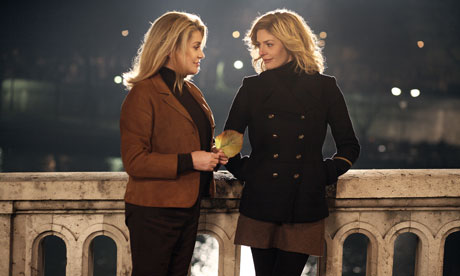
In "Beloved" there also is the added delight of
seeing the real-life mother-and-daughter team of Catherine Deneuve and Chiara
Mastroianni (shown here) on screen together for what I think is the first time -- and
playing a mother and daughter! Masterful casting.
One can't help but think of Marcello Mastroianni either
(Chiara's late father), who seems to be lurking around every corner -- and
through him, of course, Federico Fellini. And it gets better. The man playing
Chiara's father is none other than Milos Forman. Yes, THE Milos Forman
("Amadeus"). The casting is almost too inspired. It threatens to
drown the film in nostalgia for the halcyon days of European cinema.
Representing young Europe are, in addition to Mastroianni,
Louis Garrel and Ludivine Sagnier. Sagnier plays the main character in her youth: a prostitute
in 1960s Paris who falls in love with and marries a Czech doctor. In her later
years, she's played by a still-randy Deneuve. Forman (who in real life is
Czech) plays the Czech doctor in his later years. Mastroianni plays their
daughter.
Garrel plays Mastroianni's on-and-off boyfriend.
Moving things in a really different direction (and bringing
America into the mix) is an American played by Paul Schneider, a gay man who
has a boundary-breaking hard-to-define romance of sorts with Mastroianni.
I know what you're thinking: too many characters. It's true. The film does get overblown with
confusing inter-relationships, and I haven't even explained all of them. The film is also not edited well and too long (2 hours and
10 minutes).
"Beloved" is a musical kaleidoscope of love. At times,
it's a sloppy mess. But at times it beautifully captures 21st-century love, in
all its shape-shifting glory. Name one interesting person in a big city today
who has a standard relationship that perfectly fits into the box of
marital fidelity or even sexual orientation. I'm a gay man, and my greatest
loves in the 21st century have been with either single straight men or married
straight women. Complexities abound.
As I was just remarking in a review of Oliver Stone's
"Savages," the human species is evolving at lightning speed. We're
reinventing love in a fearless and exhilarating way. Honore revels in this and
throws us into the euphoric thrum of it all. But it's
not all glee. One character commits suicide. The breakdown of sexual
orientation and bourgeois forms of relationship comes at a price. It can be
profoundly disconcerting. When you love someone outside your sexual orientation, you go home alone most of the time -- both of you. Both of you know that
you're loved, but you don't have each other to hold onto in bed.
Making it even more complicated, the person who IS in your
bed knows your real love is someone else. Radical forms of love are not for the
weak.
It is flawed, but "Beloved" is also a wonder: a
joyful but conflicted embrace of the future.
Did I mention the music of "Beloved"? At times it is exquisite.
Monday, September 03, 2012
Sparkle: Whitney Houston is a Must-See

The stand-out is Whitney Houston, in her last screen
performance. She's not the greatest actress you've ever seen, but she's very
good playing a middle-aged woman crushed under the burden of a lifetime of
heartbreaks. Where she really comes alive is when she sings. She only has one
song in the film, a slow Gospel hymn, and she brings down the house.
Ms. Houston clearly could have had a second career as a
torch-song singer. Even though she lost her remarkable range in her 40s, she
still could sing the pants off a song, as long as it was in the alto range. She
sings this hymn with such profound soul that my entire audience burst into
spontaneous applause when she finished. I've almost never heard anything like
that in a movie theater.
I'm paying $200 a seat to see Barbra Streisand this fall
(who's 70!). I would easily have paid $200 to watch Ms. Houston sing alto songs
in 2012 had I been given the opportunity. Her ridiculously early death is a
great loss for the world.
The greatest value "Sparkle" has is that it
captures this spectacular artist in the last phase of her life. The movie is
worth seeing anyway. But with the added value of Houston, it's a must-see for
anyone who cares about great music.
Monday, August 27, 2012
To Rome With Love: Allen's Best Since "Vicky Cristina Barcelona"

Don't get me wrong. It's not great. It doesn't warrant a
Best Picture nomination. But it is a delightful gem.
There are several distinct, unrelated storylines in
"Rome," giving it a multi-faceted quality. The first involves an
accomplished American architect (Alec Baldwin) coming back to Rome for the
first time in 30 years. In his student days, he had spent a year or so in Rome,
and returning to the city for the first time has overwhelmed him with feeling.
He walks to his old neighborhood and meets an Architecture
student (Jesse Eisenberg) who is doing the same thing Baldwin did, a young
American having a glorious year in Rome that he'll remember forever.
Gradually, the script works in a beautiful touch of
surrealism. There aren't two separate architects. They're the same person.
Baldwin is having a tender visit with his 21-year-old self, reliving the brief
love affair he had in Rome when he was so young. Allen never gets overly
sentimental with this storyline. I found it to be a beautiful meditation on
lost youth.
Eisenberg does a wonderful job with this storyline. It's the
best I've ever seen from Eisenberg. Equally wonderful is Ellen Page ("Hard
Candy," "Juno") as the well-intentioned but self-absorbed
actress with whom the student architect has a one-week affair. One little week
he remembers forever.
The second storyline involves an American couple (Allen and
Judy Davis) in Rome to visit their daughter (Alison Pill), who is engaged to a
young Italian man. When the in-laws meet, hilarity ensues. A crazy subplot
emerges when Allen tries to convince his son-in-law's father to pursue a career
in opera. In addition to providing screwball comedy, this subplot allows the
film to present some of the most beautiful singing you'll hear at the movies
all year.
Thirdly, there's a young Italian couple from a small town
who have come to Rome to celebrate their engagement. Penelope Cruz plays a
good-hearted hooker who gets mixed up with them.
Fourth: Academy Award winner Roberto Benigni plays an
ordinary accountant flung into 15 minutes of fame, in a wildly surrealistic
send-up of the 21st-century mania for reality TV and instant fame.
"To Rome With Love" is a must-see for anyone who
loves Europe and likes his screwball comedy laced with surrealism, opera, and
post-modernism. I loved it.
Sunday, August 26, 2012
Killer Joe: The Movie of the Summer
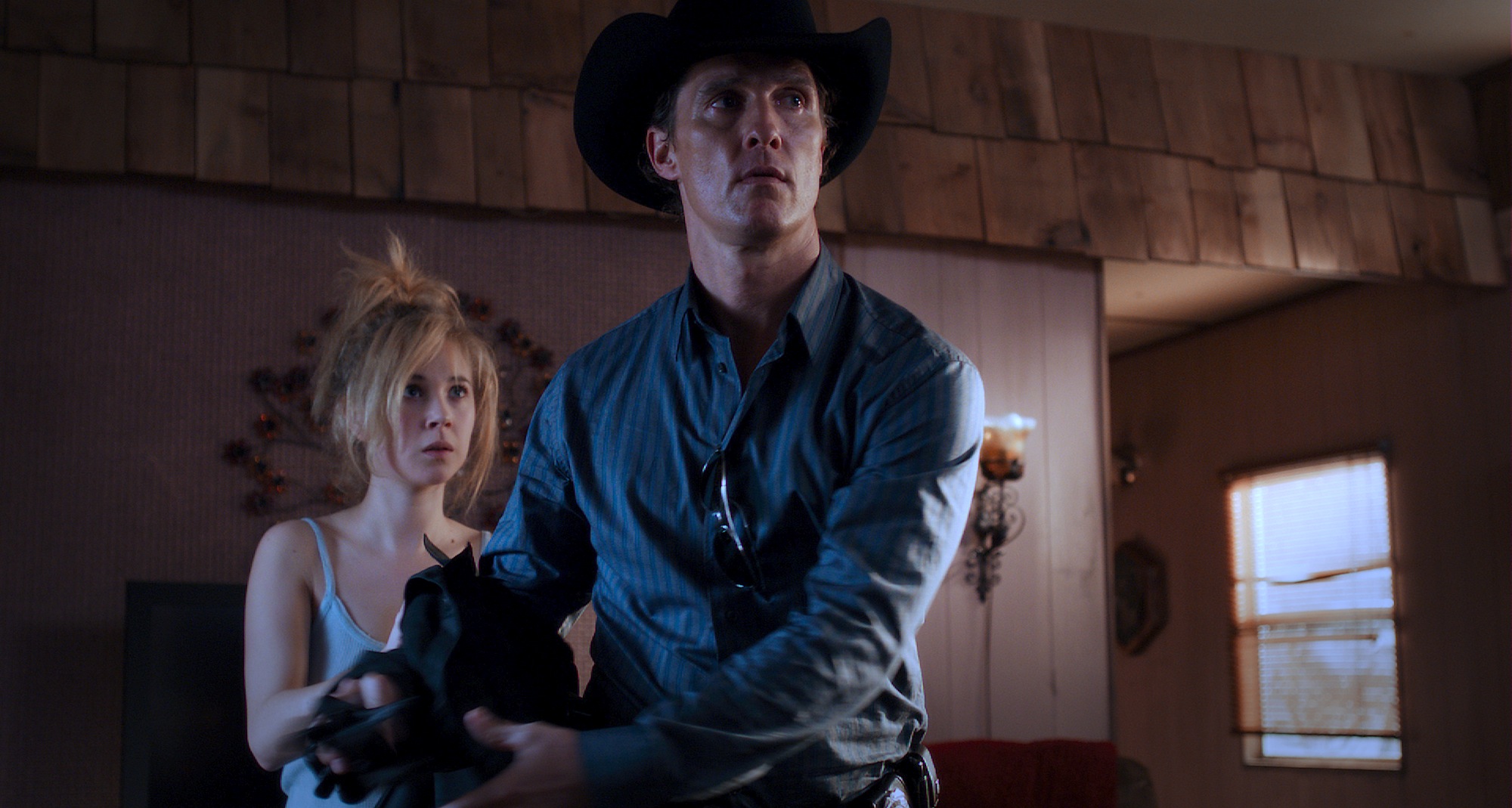
A family of trailer-park trash hire a hitman (Matthew
McConaughey) to off one of their members. They also force their 12-year-old
daughter to provide sexual services for the assassin as part of the deal. And
we get to watch her perform some of those services. Yes, it's stomach-turning.
(Twenty-two-year-old Juno Temple plays the girl in a daring performance
that must have made her parents die a slow death when they saw it on-screen.)
The script, based on a play by Tracy Letts ("August:
Osage County"), effectively uses comedy from time to time to blunt some of
the impact. On one level, you could describe "Killer Joe" as a black
comedy. But Friedkin, as he is wont to do, depicts a good amount of the
brutality in a realistic, non-comedic way. So the comedy only lightens the
atmosphere to a degree. This is a tough movie to watch.
McConaughey is having quite a year. After turning himself
into an ultra-mainstream movie star, he appears to have decided in 2010 or so
that he wanted a new career. This year, he did Richard Linklater's
"Bernie," Steven Soderbergh's "Magic Mike," and now an
art-house film with an NC-17 rating where he rapes a girl and beats a middle-aged woman
nearly to death. And he's done a great job in all these films. He's
brought fearlessness and skill to all these roles. A very impressive career
turn-around. I loathed him in 2010, and now I really respect him as an actor.
Let's see if Hollywood has the guts to nominate "Killer
Joe" for Best Picture. It deserves it. The direction is crisp and
brilliant almost from start to finish. The actors all know exactly what they're
doing. The cinematography is suitably dank and lurid. Every shot is
interestingly composed. The screenplay bristles with creativity and punch (pardon the pun). The
editing is a tour de force, moving everything along at an exhilarating pace.
I wouldn't go too far in singing its praises though. "Killer Joe" doesn't
really cut that deep. It spins its nauseating tale effectively. It is a true work of
art, exploring the underbelly of American life and human consciousness. But does it say anything truly profound or new about life? Not really. It's one helluva ride though.
Subscribe to:
Posts (Atom)
